

International Exibitions

MEDICA
ARAB HEALTH

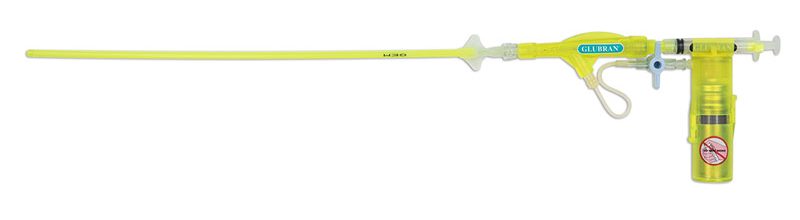
Spray device - SMALL

GLUBRAN_nebulizzatore_SMALL CHARACTERISTICS

The system permits application of Glubran 2 Surgical Glue as a spray in surgical laparotomy, laparoscopy and thoracoscopy procedures.
For applications of Glubran 2 Surgical Glue see Intended Use of the Glubran 2 Surgical Glue Technical Card.

GEM_nebulizzatore_small_schema

THE SYSTEM CONSIST OF:

  • a steel canister (figure/point 1) housed in two polycarbonate half-shells (figure/point 2). The canister is filled with non-toxic, non-flammable HFC134/a (1,1,1,2 tetrafluoroethane) gas, used as the glue propellant. A small tube with a stopcock for passage of the gas connects to the canister valve through the upper half-shell (figure/point 3). The holder for the glue-containing syringe is joined to the top of the upper half-shell (figure/point 4 detail).
  • a flexible external sheath, 30cm long, external diameter Ø 5mm (figure/point 7).
  • This sheath contains a 31 cm long flexible yellow catheter, with an external diameter of 2mm (figure/point 5).
  • A tube fitting for connection with the syringe and the small gas tube (figure/point 8).
  • There are two small tubes inside the catheter, one for the passage of the gas and one for the passage of the glue. Gas and glue flow together in a spray tip which is inserted into the catheter (figure/point 6) at the distal extremity to atomise the glue. A tube fitting is located at the proximal end of the catheter and connected with the small gas tube with a female luer lock to be connected with the luer lock of the syringe containing the glue.

METHOD OF USE

GEM_nebulizzatore_small_uso

After removing the catheter from its packaging in sterile conditions, aspirate the glue into one or both of the syringes included using a needle with a luer adapter.

Remove the needle, screw the syringe (fig. 1) to the luer adapter of the free tube and place it (fig. 2) in the holder on the upper half-shell of the canister.
Click in place being careful not to apply pressure to the extremity of the lower half-shell. Check that the stopcock on the gas valve is closed.

Take the canister in your hand (fig.3) and press the syringe and the distal extremity of the lower half-shell at the same time, bringing the two halves of the shell together to hook in place.
The canister valve is now activated and the gas is at operating pressure.

The canister must never be turned upside down during the gas flow. It must always be used with the valve facing upwards.

Open the stopcock and make sure that the gas is flowing out of the catheter tip.

Grasp (fig. 4) the gas canister in one hand and, at the same time, take the distal end of the catheter in the other.
Test the spray on a surgical towel before using on the patient so as to judge the correct distance between the catheter tip and the area to be treated (2-5cm) and the right pressure to exert on the syringe plunger. During the procedure, do not allow the tip of the catheter to come into contact with blood or organic fluids. If this occurs, the glue will polymerize on the catheter tip, causing it to become clogged.
During the surgical procedure, after each application of glue, allow the gas to escape for 5-7 seconds before closing the stopcock. This allows the spray tip to be cleaned thoroughly before the next application.

At the end of the surgical procedure, empty the gas canister completely before disposal of the spray device.

The amount of glue to be applied can vary from 1 to 4 ml of product, according to the type of procedure and surface to be treated.

INTENDED USE

For surgical laparotomy, laparoscopy and thoracoscopy procedures.

WARNING

  • The atomiser must be employed exclusively by doctors trained in its use.
  • Do not use the product if the package has been damaged or tampered with.
  • The gas canister is under pressure. It must not be exposed to direct sunlight or to temperatures above 30°C. Do not perforate or burn even after use.
  • Always check proper functioning of the system before use of the spray device, by first testing the spray on a surgical towel.
  • The canister must never be turned upside down during the gas flow.
    It must always be used with the valve facing upwards.
  • When the surgical procedure has been completed, empty the gas canister completely before disposing of the spray device.
  • To obtain a correct application of the glue during the laparoscopic procedure, reduce the CO2 pressure down to 8-9 mmHg or block the CO2 flow in order to prevent the creation of vortexes.
  • Use protective eyewear during the procedure.
  • If eyes should come into accidental contact with the glue, rinse immediately with water. If the product has polymerised , it will detach spontaneously after about 2-3 days.
  • The system cannot be used to spray any liquids other than Glubran 2 Surgical Glue.
  • It is a single-dose system. Do not re-use the system as this may cause a risk of infection for the patient and a reduced effectiveness and efficacy of the device.
  • The manufacturer declines any responsibility for damage caused by improper use or any use other than those described on this Instruction Sheet.

STORAGE

Keep product away from direct sunlight and do not store at temperatures above 30°C.

EXPIRY DATE

See expiry date on package.

STERILITY

The product is sterilised by gamma ray radiation.

PACKAGING

Single pack.

PRODUCT CODE

G2-NBT-SMALL.